Why Office Pods Are Important for Employee Wellbeing
Updated: Jul 30
Employee wellbeing has become one of the most-cited priorities in workplace strategy, and one of the least defined. It shows up in engagement surveys, benefits packages, and mission statements, but rarely in the physical design of the office itself. That's a gap, because the research on burnout, sensory load, and recovery time all points to the same conclusion: the environment people work in is not a backdrop to wellbeing, it's an active input to it.
Gallup's most recent State of the Global Workplace research found that 72% of remote and hybrid employees report burnout, compared to 63% of fully in-office employees, and that employees carrying increased workloads report burnout at even higher rates. The World Health Organization doesn't classify burnout as a medical condition, but it does classify it, formally, in the ICD-11, as an occupational phenomenon resulting from "chronic workplace stress that has not been successfully managed." In other words: this is a workplace design problem as much as an individual one.
Office pods are one of the more direct responses to that problem, not because they're a wellness amenity, but because they give people something the rest of the open-plan office doesn't: a small amount of control over their own sensory environment.

What "Wellbeing" Actually Means in an Office
Wellbeing initiatives tend to default to benefits: gym stipends, mental health apps, wellness days. Those matter, but they operate outside of work hours or outside of the workspace. They don't touch the thing employees actually spend eight hours a day inside of: the physical environment.
Environmental control, having some ability to manage noise, light, temperature, and privacy, is a more specific and more testable version of wellbeing. It's also the version most open-plan offices weren't designed to offer. A worker who can't get away from ambient noise, overhead lighting, or a constant sightline from their desk isn't dealing with a minor annoyance. They're dealing with a sustained, low-grade environmental stressor that accumulates over a working day, a week, a year.
The Research on Sensory Load and Recovery
The clearest evidence for this comes from research on neurodivergent employees, but the underlying mechanism applies more broadly. A 2024 systematic review published in Applied Psychology found that noise, lighting, and temperature were the distractions neurodivergent employees reported most frequently in the office, and that workers satisfied with their workplace adjustments reported significantly higher wellbeing and workplace satisfaction. The same review found that having a space to retreat to was one of the most effective adjustments for employees with auditory or visual hypersensitivity. Separate estimates put the neurodivergent share of the workforce at roughly 1 in 5 people, and burnout among neurodivergent workers specifically at 65%, notably higher than the workforce average.
The takeaway isn't that pods are a neurodivergence-specific solution. It's that the accommodations which help neurodivergent employees regulate their sensory environment, quieter space, adjustable lighting, the option to step away, tend to improve conditions for everyone. Universal design research consistently finds that workplaces built to accommodate a wider range of sensory needs perform better across the board, not just for the employees the design was aimed at.
Air and Light Are Not Cosmetic Details
Two environmental factors get less attention than noise, but the data on them is just as direct: air quality and lighting. A Harvard T.H. Chan School of Public Health study, part of its ongoing CogFX research, found that a 400 ppm increase in indoor CO2 was associated with a 21% decrease in cognitive test scores across domains including crisis response and information use. Most offices operate well above the ventilation rates used in that study's best-performing scenario. It's a striking number for something as unglamorous as air exchange: how well a room is ventilated has a measurable, near-immediate effect on how well the person inside it can think.
Lighting has a comparable, if less studied, effect. Flicker, poor color rendering, and glare contribute to eye strain and fatigue over the course of a working day, particularly for employees spending extended stretches at a single workstation.
None of this is about aesthetics. It's about whether the room someone works in is actively working against their cognitive performance or supporting it.
Privacy is a Wellbeing Feature, Not a Perk
There's a category of workplace need that doesn't get discussed as often: employees need somewhere to have a private conversation that has nothing to do with focus or productivity. A call with a doctor. A difficult conversation with a manager. Ten minutes to decompress after a hard meeting. None of this fits into a conference room booked in thirty-minute increments, and none of it happens well at a desk in an open floor plan.
Employees are more likely to use mental health and wellbeing benefits when they trust their privacy will be protected. An office with no private, low-visibility space to step into is quietly telling employees that this kind of need wasn't planned for. That's a wellbeing gap that shows up in engagement scores and retention conversations even when nobody names it directly.
What This Looks Like in an Actual Office
Not every pod is built to address the same version of this problem, and it's worth being specific about which environmental factors matter most for which use case.
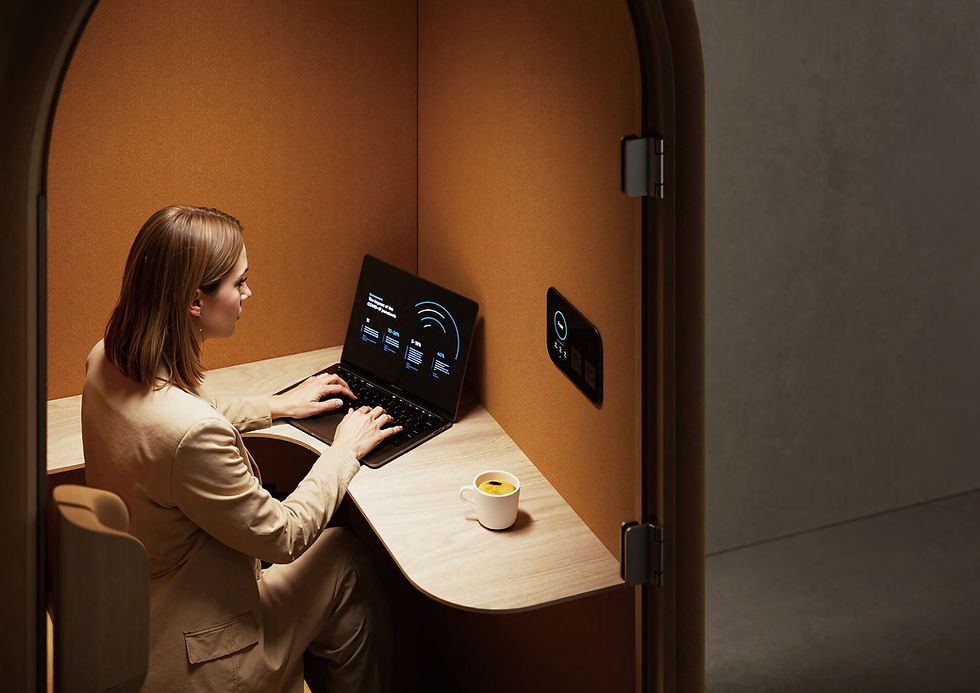
For extended, heads-down work, sessions that run long enough for lighting quality and air exchange to actually matter, the relevant specs are things like CRI-rated lighting, flicker-free output, and balanced-pressure ventilation with automatic air-refresh. Alcove's Aura Series was engineered around exactly this: OSRAM CRI 92 lighting and a ventilation system that refreshes the interior air automatically, built for people spending real, sustained hours inside the pod rather than five-minute calls.
For the decompression and privacy use case, a quiet space to step into for a private call or ten minutes away from the floor, the priority is less about extended-session comfort and more about creating a space people actually want to use. Alcove's Arc Series is built for that lighter, more intentional use: lounge seating, a "Relax" scene mode, and a design language suited to spaces like wellness rooms or quiet corners rather than another meeting room.
The point isn't that either series is a wellbeing solution on its own. It's that when facilities and people teams are evaluating enclosed space for this purpose, the right question isn't just whether it has four walls, it's whether the space was actually engineered around the environmental factors the research identifies: noise, light, air, and privacy.
Frequently Asked Questions
Does workplace design actually affect employee burnout?
Yes, though it's one input among several. The WHO's ICD-11 defines burnout as resulting from chronic, unmanaged workplace stress, and research on sensory load, air quality, and environmental control all point to the physical workspace as a measurable contributor to that stress, alongside workload, management, and role clarity.
What office design changes have the most evidence behind them for wellbeing?
Three stand out in the research: reducing ambient noise and giving employees a way to escape it, improving ventilation and air exchange, and providing lighting that reduces eye strain and glare. Access to a private, low-visibility space for sensitive calls or short recovery breaks also shows up consistently in employee satisfaction research.
Are office pods only useful for neurodivergent employees?
No. Research on neurodivergent-specific accommodations, like access to quiet retreat space, tends to show that these same adjustments improve conditions for the broader workforce as well. Roughly 1 in 5 employees are neurodivergent, but environmental control benefits most people who spend a full working day in the same space.
What's the difference between a pod built for focus work and one built for decompression?
Pods built for extended work sessions prioritize things like lighting quality (measured by CRI) and continuous air exchange, since those factors compound over hours of use. That's the Aura approach. Pods built for shorter, lighter use, like a quiet break or a private call, prioritize comfort and a sense of retreat over work-session specs, which is closer to how Arc is designed.
Does air quality really affect how well people think at work?
Yes. A Harvard T.H. Chan School of Public Health study found that a 400 ppm increase in indoor CO2 was associated with a 21% drop in cognitive test scores, and that better-ventilated offices produced measurably higher performance on tasks like crisis response and information use.
Alcove Pods. Great office pods. Honest price.